6 Tips to Reduce and Manage Technical Debt in 2026


Four years ago, a winter storm hit the United States. Most airlines recovered within days, but Southwest Airlines took weeks. It cancelled over 16,000 flights and racked up nearly $1 billion in refunds and fines.
Surprisingly, the actual culprit wasn’t the weather but its own crew scheduling system. The system was riddled with technical debt that engineers flagged for years. They knew about it—but nobody managed the problem. As they launched new features or built temporary workarounds, the debt piled up until the system finally crashed.
It’s something every engineer is familiar with. In regulated industries like banking, insurance, and healthcare, it’s often the price of shipping under real-world constraints.
In this article, we’ll explain what technical debt is and how you can manage it even as you start shipping faster by using AI in your development process.
What is technical debt?
Technical debt is the implied cost of future rework caused by choosing a faster or easier solution today instead of a better approach that would take longer.
Ward Cunningham, an American computer programmer and author, coined the term in 1992. At the time, he drew a parallel to financial debt:
“Shipping first-time code is like going into debt. A little debt speeds development so long as it is paid back promptly with a rewrite. The danger occurs when the debt is not repaid. Every minute spent on not-quite-right code counts as interest on that debt.”
Just as financial debt isn’t inherently bad, technical debt isn’t either. A software company racing to validate product-market fit might consciously take on debt to ship faster. But the problem starts when the debt lacks visibility in planning and prioritisation, tending to compound if left unchecked.
For example, in banking, it could mean that you’ve built a payments integration held together by undocumented scripts that only one engineer understands. Or in healthcare, you’ve built a records module on deprecated frameworks you can’t touch anymore.
When things break (and they will), you’ll end up with outages, security issues, and slow-loading software that impacts your business. The worst part is these latent issues often surface under load or during incident responses.Your mean time to resolution (MTTR) increases and these issues also block planned work.
What causes technical debt, and why does it snowball?
You don’t end up with technical debt because of one bad decision. That’s why you need to understand where the problem actually starts to troubleshoot it effectively.
Here are a few reasons:
Short-term trade-offs without exit criteria
Sometimes you take on debt deliberately. You’re racing toward a product launch or a competitive window, and you make a conscious choice to ship something that works now with the intention of fixing it later. It’s normal to take on debt consciously, but when you don’t document it and assign ownership to clean it up at the right time, it becomes a liability.
As you keep shipping new features, your team moves on to the next priority, and the debt keeps accruing interest. Feature flags are one such example. Every flag you create lives in your codebase, and if you don’t have a built-in automation and process for feature lifecycle management, it can become debt.
This webinar covers how to use AI to manage and minimise feature flag debt:
Poor practices that compound over time
Not all debt is intentional. Some of it accumulates through everyday workarounds that pile up over time. For example:
- Outdated dependencies that fall behind on security patches because updating them would require refactoring adjacent code.
- Orphaned feature flags that outlive their original purpose and leave dead code paths and conditional logic that nobody wants to touch.
- Missing or incomplete documentation that forces new engineers to reverse-engineer system behaviour.
- Gaps in test coverage that make changes feel risky, which leads to even fewer changes and even less coverage.
- Inconsistent coding standards across teams create friction when services need to integrate.
While these issues may seem minor in isolation, they often become root causes later. Just like in Southwest Airlines’ case, incident retrospectives routinely trace outages back to the interaction of multiple “minor” issues compounding into something dangerous.
Continuously ageing infrastructure
As your software infrastructure ages, technical debt becomes the norm. Either your frameworks fall out of favour, or you deprecate services that you don’t need anymore. But if they’re not cleaned up, it could lead to massive compliance and security risks.
In fact, Morning Consult and unqorkAI’s survey reported 85% of business and technology leaders say legacy systems impair their ability to launch new solutions, while 77% of these leaders say it paralyses their ability to innovate.
When you’re in a regulated industry, even minor changes are scrutinised. But that’s no reason to accumulate technical debt and avoid modernising. Many regulators treat unmanaged technical debt as a control failure. That’s why operational resilience frameworks like the Digital Operational Resilience Act (DORA) for the financial sector explicitly require firms to manage legacy system risk, for example.
Gaps in development visibility and a lack of ownership
The technical challenges are one side of the equation. But on the other side, you have the social and organisational dynamics that play a huge role in managing technical debt.
Here’s an example from McKinsey on what ownership during tech-debt paydown looks like:
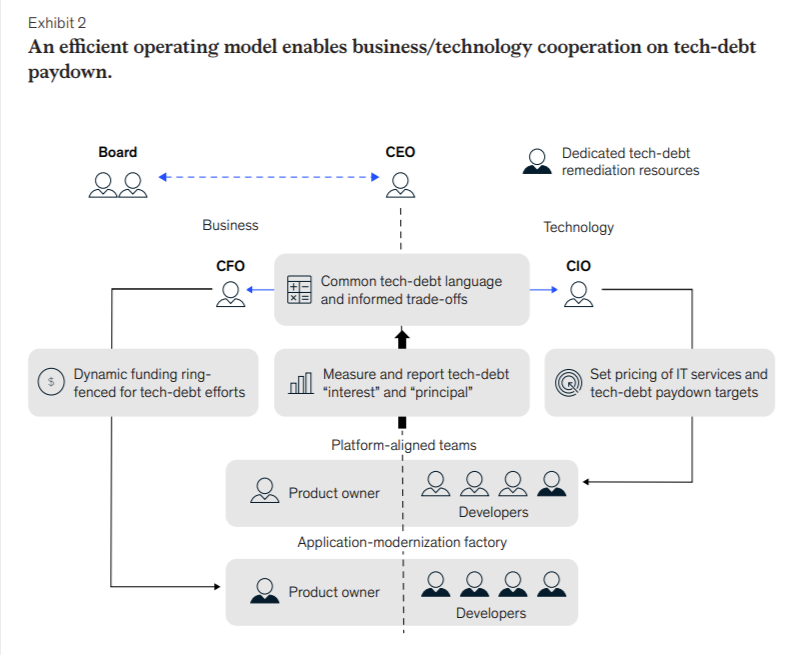
When nobody on your team truly owns a system and prioritises its upkeep, you’ll end up with an invisible mountain of debt piling up over time. If a system’s health isn’t reflected in anyone’s OKRs or performance metrics, it won’t get maintained, irrespective of how critical it is to production traffic. It doesn’t show up in planning sessions and snowballs because there are no clear stakeholders or timelines to manage it.
You only find out when it reaches the tipping point—large enough to cause a massive failure. And by that point, remediation is urgent and expensive, which can impact your bottom line.
6 tips to manage technical debt effectively
Here are a few ways in which you can manage and reduce technical debt:
1. Make technical debt visible and measurable
You can’t manage what you can’t see. The first step should be to bring it into the open so you can track, prioritise, and manage it alongside your future sprints. Start by auditing your infrastructure and creating a shared inventory of known items, and then log it using these fields:
- What the debt is
- Why it exists
- What’s the cost of leaving it
This way, you’ll know how to categorise them and what to prioritise first.
For example, you can categorise it by type (infrastructure, code quality, dependencies, documentation) or by risk level (how likely it is to cause problems and how severe those problems would be).
2. Prioritise debt with real metrics
Every item you see isn’t equally urgent, and treating it that way will only pull you away from the important things.
Rank your technical debt based on factors like:
- Frequency of incidents or bugs traced back to the affected code
- Developer time lost to workarounds, confusion, or slow builds
- Security exposure or compliance risk
- Blocking effect on planned features or integrations
- Causing friction in user experiences
When you tie debt to measurable impact, it becomes much easier to make the case for addressing it, while also making it clearer which items deserve attention first. These factors map to outcomes leadership cares about such as incident frequency and its effect on reliability SLAs and security exposure during the incident.
When you frame debt in these terms, you turn it into a conversation about resource allocation, not a simple engineering issue that can be fixed later.
3. Bake debt repayment into sprint planning
Instead of hoping you get to addressing the debt, it’s better to actually queue it up in your sprints. There’s always another feature waiting in your roadmap, so you might as well work on maintenance and development at the same time.
You can reserve a fixed percentage of each sprint for debt work. For instance, 10% of your actual capacity, as it won’t require approval each time.
Other than that, you can also attach debt items directly to related feature work. If you’re touching a particular area of the codebase, it’ll trigger a review of any outstanding issues in that area.
4. Use feature flags to prevent and contain debt
While feature flags have become synonymous with progressive delivery and experimentation, they’re also an excellent tool for managing technical debt.
That said, they’re also a known contributor of technical debt. As you keep using feature flags to experiment and deploy features, it’s possible that your team forgets to clean up. This is especially true when you don’t have clear governance in place to prevent this from happening.
But if you use them correctly, they can help you ship faster without taking shortcuts.
At their best, feature flags reduce the biggest sources of long-term pain:
Smaller, safer changes (less “big bang” debt)
Instead of bundling large releases (which are harder to test, debug, and roll back), flags let you ship in smaller increments. This reduces the chance of complex, hard-to-untangle failures later.
Reversibility instead of workarounds
Without flags, teams often add quick fixes or defensive code because rollback is painful. Flags give you a kill switch, so you don’t need to stack hacks on top of hacks.
Less coordination overhead
By decoupling deployment from release, teams don’t need to build brittle, tightly coupled systems just to coordinate launches. That avoids structural complexity building up over time.
Better validation = less wasted build
Teams can test features with real users before fully committing, which means less engineering effort goes into features that never get used (a major hidden form of technical debt).
5. Clean up proactively with automated signals
Manual tracking only goes so far. As your codebase grows and your team scales, you need automated systems to surface that debt.
Consider using an observability platform with a feature flagging tool to do this. If you connect tools like Flagsmith to Grafana, you can monitor the performance of flagged features in real time. If the error rate spikes or you notice unusual behaviour, it could be due to an old feature or legacy code in your app.
Grafana Integration: Feature Flags & Observability
Additionally, you might have stale flags within your codebase that’ll need to be removed. If you use a tool like Flagsmith, these will be surfaced automatically for you based on thresholds you set.
6. Align governance with how teams actually work
Nothing happens in a vacuum these days, and that includes technical debt management. You need to ensure it aligns with the governance structures already in place within your organisation.
In short: don’t treat debt as another thing to do. Instead, bake it into the way you build software and manage releases.
For instance, if you use change request approvals, make sure debt-related changes flow through the same system. If you gate deployments based on test results, add health checks as an additional signal. Tools like Flagsmith’s Release Pipelines help you do that. As a result, you can enforce automated governance without creating new bottlenecks.
This will require you to:
- Assign clear ownership internally
- Use guardrails that actually match your delivery pipeline
- Attach technical health KPIs to ensure you’re on track
Your team will be encouraged to surface and report on these metrics without feeling like it’s another thing on their plate.
It’s time to manage technical debt the right way
In hindsight, Southwest Airlines didn’t fail because its engineers made bad decisions. But because their known debt stayed invisible to the people who could’ve fixed it.
That said, this incident wasn’t an outlier. It plays out in almost every engineering organisation we see today. We know that it’s unavoidable and necessary in some cases. That’s why the goal is to make it visible and avoid reaching a point where failure is inevitable.
The only way to do that is to build a culture where debt is surfaced often and give your team the tools they need to make it happen.
Feature flags can help you reduce technical debt as you go. Curious how it works? Start a free trial today.





















































OpenTelemetry, without the vendor lock-in: Introducing full observability for Open Source and Self-Hosted Flagsmith customers