Deploy Anywhere and Own Your Releases with Open-Source Feature Flags
Full transparency, no vendor lock-in—Flagsmith is the feature flag platform built in public and kept that way.
Trusted by top development teams


.svg)



BSD-3-Clause licence
One of the most permissive open-source licences available—no restrictions on commercial use.
Core will always be open
Flags, segments, user targeting, and remote configuration. Always free, always open.
Compatible with OpenFeature
Stay vendor-agnostic. Switch tools without rewriting your existing development workflows.
Most open-source tools aren’t as open as they claim
The “open source” label gets stretched. Many tools keep core functionality behind Enterprise plans or switch to restrictive licences as they scale.
Flagsmith is different. We’re committed to open source.
Core functionality—feature flags, remote configuration, user targeting, multivariate flags, and targeting rules—is BSD-3-Clause licensed, free to use in production, and available to inspect, fork, and self-host without restriction.

Everything you need to ship faster, release safely, and stay vendor-free
No artificial limits on your core feature flag functionality, just a complete platform you can inspect, fork, and deploy yourself.


Inspect everything
Most of Flagsmith’s full source code is available on GitHub—including the flag engine, SDKs, and infrastructure.
View the open issues, and contribute directly to the project. Community-driven development means bug fixes ship faster, and the direction of the platform is shaped by the development teams using it.
Deploy on your terms
Self-host Flagsmith on your own infrastructure using Kubernetes and Helm, run it on Google Cloud, AWS, or Azure, or use the hosted SaaS version.
With Flagsmith’s flexible deployment, development teams aren’t locked into a vendor’s infrastructure or their pricing model.
Most teams are up and running in under a day.


Integrate across 15+ programming languages
Flagsmith’s SDKs cover most popular programming languages and frameworks—and they’re all open source.
Use them in server-side applications, mobile apps, or web front ends. Cross-platform remote configuration and flag management from one platform, without additional configuration files or manual deployment steps.
Decouple deployment from release and ship on your terms
Feature flags let you deploy code to production and release it separately.
Wrap a new feature in a flag, ship it, and control who sees it from the Flagsmith dashboard—without new code changes or app store submission.
Use canary deployments to release to a small percentage of users first or run A/B testing and multivariate experiments across multiple environments.


Scale from open source to Enterprise without switching tools
Flagsmith’s open-source version includes core functionality: unlimited feature flags, remote config, user targeting with user attributes, and server-side evaluation.
When your team needs advanced features—audit logs, approval processes, SAML/SSO, and enterprise support—the Enterprise plan adds them without requiring you to migrate platforms or rebuild your integration.
The full toolkit, not just the flags
Feature flags are the foundation, but a lot more comes with Flagsmith's open source platform.
Remote Config
Configure feature values remotely, not just on/off. Change checkout options, UI elements, or content without touching your source code or waiting for a deployment.
Segmentation
Target flags to specific users, groups, or user attributes. Roll out to beta testers, internal teams, or any segment you define without code changes.
MCP Server
Manage feature flags directly from AI-assisted development workflows. Soon to be available on self-hosted and private cloud, not just SaaS.
Kill Switches
Instantly disable a broken feature in production without a rollback or redeployment. If something goes wrong, remove it in seconds.
Edge Proxy
Run the Flagsmith flag engine close to your own infrastructure for efficient flag evaluation, without hitting the core API on every request.
Integrations
Connect Flagsmith with your existing analytics, monitoring, and project management tools — including Grafana, Slack, Amplitude, and New Relic.
Trusted by engineering teams who care about what they ship
“We decided on Flagsmith not just because of the system’s flexibility, but also the great support, the fact that you guys are open source and the great documentation.”
"Before Flagsmith, we didn't have this level of fine-tuned control. Now, we can go to market in smaller slices, increasing our confidence in the final product."
"We need to focus our time and energy on building the product, not building the tools that make the platform work."
Why KB chose open source over LaunchDarkly, or building their own
Komerční Banka (KB), a leading Czech banking institution with over 1.6 million customers, ran three proofs of concept before choosing a feature flag service: LaunchDarkly, Flagsmith, and an in-house build.
Open-source flexibility, strong documentation, and the ability to self-host sensitive data on their own infrastructure made Flagsmith the clear choice.
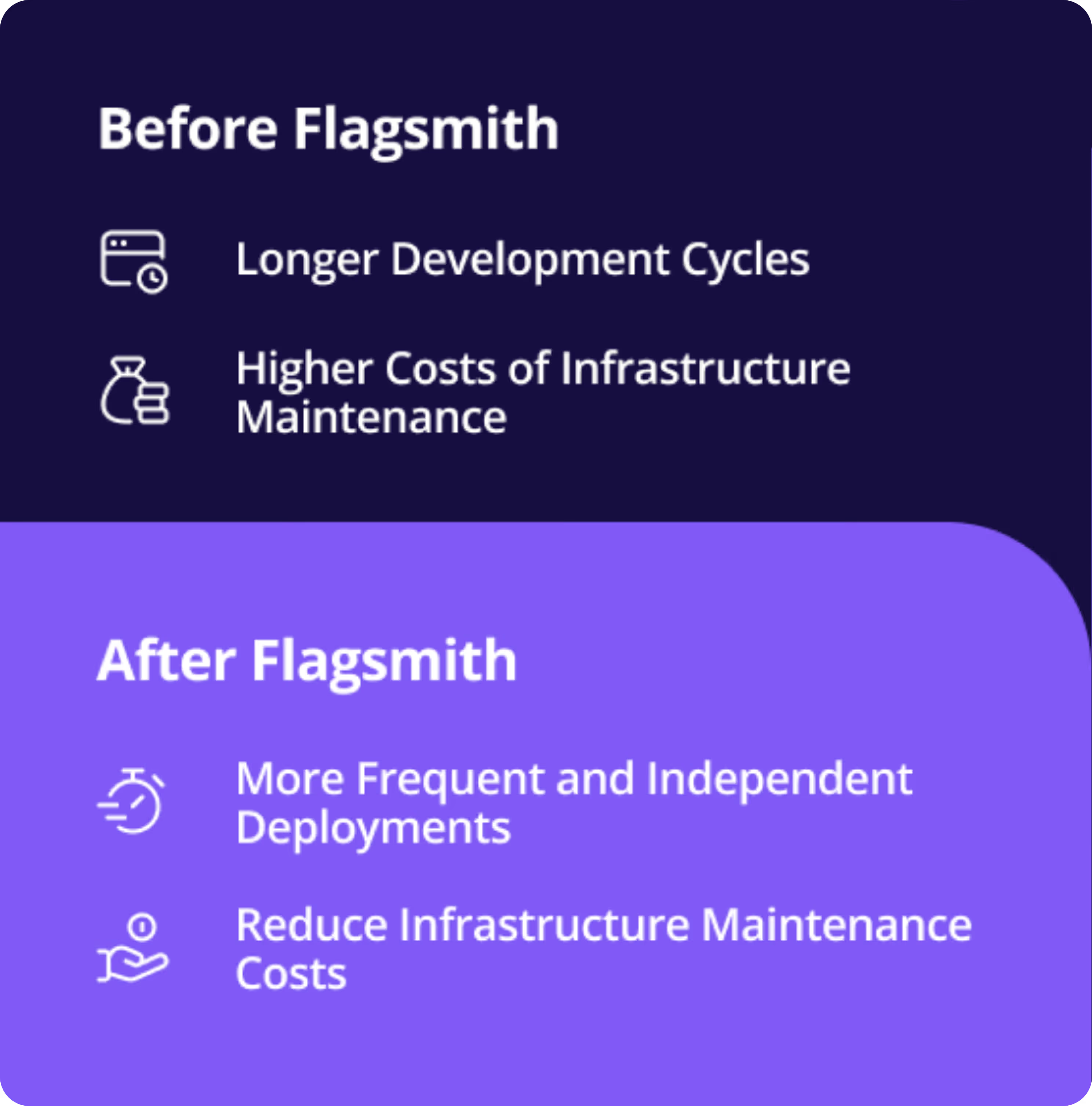
Today, feature flags enable the team to manage feature rollouts progressively, deploy continuously to development environments, and keep development teams moving independently without coordination overhead.

What to look for in open-source feature flag tools
Not all open-source tools are built equal. When evaluating your options, it’s worth checking:
Licence type. BSD-3-Clause and MIT are the most permissive licences. SSPL and BSL restrict commercial use—check the small print before committing.
SDK coverage. A good feature flag service should cover the programming languages and frameworks your team actually uses, including server-side applications, mobile, and web.
Self-hosting options. Run it on your own infrastructure, with Helm charts, Docker support, and clear documentation to help you onboard.
Upgrade path. Open source should be a genuine deployment option. Make sure core functionality stays open and the path to Enterprise adds governance, not the basics.
Community health. Active contributors, regular security patches, and a public roadmap signal a project that will keep improving. Custom activation strategies and statistical analysis for experimentation are signs of a mature platform.
Open-source feature flags vs. building your own
Most development teams start simple—a config file, a database table, or a few boolean switches. But as usage grows, so does complexity: multiple environments, flag targeting, audit trails, and a UI non-engineers can use without a deployment.
Building that in-house is a significant investment in maintenance and engineering time. Teams can spend months building a solution they could have deployed in hours.
Flagsmith's open-source version gives you the complete feature set—user targeting, remote config, A/B testing, and analytics integration—without the build cost. Plus, you keep complete control over your source code and data.

Ready to get started with open source feature flags?
Use cases for open source feature flags
Decouple deploy and release
Achieve continuous deployment by deploying behind flags, and then only toggling them on when a release is scheduled.
Canary Deployments
Using Flagsmith, you can release new features to a small percentage of your users initially, and then enable them for the rest of your users over time.
A/B/n Testing
Once you’ve integrated the Flagsmith SDK and gated a feature with a flag, you can then easily use that flag to power A/B/n tests.
Open-source feature flags are feature flags served by publicly available source code, meaning you can inspect how they work, modify the source code, and self-host the platform on your own infrastructure. Like any feature flag or feature toggle, they let teams turn new features on or off in production without deploying new code.
An open-source feature flag service adds full source code access, the ability to contribute improvements, and no usage data leaving your environment. There’s no vendor lock-in.
Flagsmith’s core functionality stays open, always, which means you can use open source feature flags and feature management no matter what.
Read more about our build decisions in our open letter to developers.
Core feature flag functionality is open source: flags, segments, identities, remote configuration, user targeting, multivariate flags, and local evaluation across all supported languages.
Enterprise-level governance and management features—audit logs, role-based access control, SAML/SSO, change requests, and enterprise support—are not open source, but are available on the Enterprise plan. You don’t need to migrate platforms or rebuild your integration to upgrade.
Flagsmith’s core feature flag functionality is completely open source, including flags, segments, identities, and basic feature management.
Some enterprise-level governance and management features are paid rather than fully open source, but the feature flagging itself will always remain open.
Open source feature flagging solutions are better because:There are a few strong reasons:
° You get complete transparency into how your feature management works
° You can contribute improvements and bug fixes to the product
° You’re not locked into a contract you don’t want
° You retain full control over your data
For teams with specific compliance or infrastructure requirements, the ability to self-host and audit the source code is often a hard requirement rather than a preference.
OpenFeature is an open specification that offers a vendor-agnostic, community-driven API for feature flagging. It works with feature flag management tools like Flagsmith, as well as in-house solutions.
Flagsmith is proud to be an OpenFeature provider, meaning your code can use the OpenFeature SDK to interact with Flagsmith, and if you ever switch tools, you won’t need to rewrite your integration.
It’s the most direct answer to vendor lock-in in the feature flag space.
Yes. The open-source version is production-ready and used by development teams in banking, healthcare, and enterprise environments.
Self-hosting options include Docker, Kubernetes with Helm charts, and a range of cloud providers. There are no API request limits on self-hosted deployments.
A simple in-house system works for basic on/off switches. Operational complexity grows fast once you need multiple environments, user targeting, targeting rules, audit trails, and a management UI that non-engineers can use to make changes without a code deployment.
Flagsmith’s open-source version covers all of that, with the option to add enterprise support and advanced governance features when you need them.
Flagsmith supports 15+ programming languages, including TypeScript, Python, Java, C#, Go, Ruby, PHP, Swift, Kotlin, Flutter, and more. All SDKs are open source.
For server-side applications, Flagsmith supports local evaluation mode across all supported languages—meaning flag decisions happen locally, without a network request to an external service.
Yes! We have a robust community of contributors. Here are our guidelines for contributing to open source feature flags. If you have any questions about your contribution, you can also chat with us on Discord.