

Flagsmith vs Eppo: A Detailed Comparison for Engineering Teams
Flagsmith and Eppo offer feature flagging tools to help you test features, monitor performance, and then roll them out. But the mechanics and purpose of each platform are different. Find out which one’s the better fit for you.

Built for engineering teams who need control over modern feature delivery. Flagsmith is an open-source feature flag and remote config platform with flexible deployment options including self-hosting.

Built for data and product teams running warehouse-native experiments. Eppo offers statistical analysis tools that connect directly to your data infrastructure to measure feature impact.
Flagsmith is trusted by top development teams


When you’re evaluating feature flagging platforms, Eppo and Flagsmith tend to appear on the same shortlist. But in reality, they’ve been built to solve very different problems.
In this guide, we’ll break down the differences between Eppo and Flagsmith so that you can choose the platform that best fits your team’s needs.
Eppo vs Flagsmith at a glance
Eppo is a warehouse-native experimentation platform. It connects directly to your data warehouse, such as Snowflake, BigQuery, or Redshift, and runs experiment analysis on top of your existing metrics. The platform does have feature flags, but they’re meant to be used as experiment gates.
On the other hand, Flagsmith takes a completely different approach. It’s an open-source feature flag and remote configuration platform built for engineering teams who need control over how software gets delivered. Its main goal is to help you roll out features with more confidence by decoupling deployment from release.
Comparing Eppo vs Flagsmith



Jindrich Kubat
,
Head of Development
Komerční Banka

The key differences between Eppo and Flagsmith
If you need to focus on feature flagging and remote config
Because of its focus on experimentation, Eppo treats feature flags as a means to an end. They exist to power experiments, route traffic to variants, and collect data for analysis. That works well if experimentation is your primary need right now, but it leaves gaps if you’d like to use feature flags for anything else.
Most engineering teams use it to kill a feature when things go wrong, or to roll out features after testing them with a subset. If you have both short- and long-term needs, Flagsmith is a better fit. It was built with this reality in mind.
You get:
- Boolean flags, multivariate flags, and remote configuration values (strings, JSON, integers)
- Segment-based targeting with flexible user attributes
- Environment management across development, staging, and production
- Flag scheduling for timed releases
- Local evaluation mode for low-latency, high-volume applications
The most important capability is remote configuration. You don’t have to hard-code values or manage environment variables across deployments. You can change these configurations in real time without redeploying—saving time and resources in the long run.
User reviews
Jindrich Kubat
,
Head of Development
Komerční Banka
If you want a platform built for engineers primarily
When you look at Eppo’s platform, it’s clear it was designed for data science and product teams, not for engineering itself. These teams need a strong analytics platform to run statistically rigorous experiments. But engineers are just a part of the workflow, they’re not the centre of it.
This shows up in how the product works. You get more flows for experiments and can integrate with your warehouse’s data. The feature flags are there to serve this use case mostly.
But Flagsmith flips this. It was built for engineers, and this is evident in the platform’s design. One of the first things you’ll see on the platform is how to set up a flag to roll out or test new features. The dashboard is simple enough to set up a flag in under five minutes.
“Flagsmith offers a clear UI that both technical and business users have no problem understanding. Managing flags and integrating them in our workflow is straightforward and does not get in the way, without hiding everything behind dark magic.” — Olivier H., JUG leader (G2 user)
If you want more predictable and affordable pricing
After its acquisition by Datadog, Eppo hasn’t published its pricing on the website. You’ll need to contact sales to get a quote, which typically means the cost scales with your data volume, number of experiments, and seat count.
But Flagsmith takes a simpler approach. It has a free tier and a paid Start-Up tier for growing teams. If and only if you have enterprise requirements, contact the sales team. But even then, it’s more about whether you need governance features and on-premise deployment than the sheer number of flags.
If you want an on-premise deployment option
Well, this one is straightforward. Eppo is a cloud-only SaaS platform. Your experiment data lives in your warehouse, but the application itself runs on their infrastructure.
For many teams, that’s perfectly fine, but if you’re in a regulated industry, you’ll need something more flexible and robust.
That’s why Flagsmith offers three deployment options:
- Cloud (hosted on Flagsmith’s infrastructure)
- Private cloud (single-tenancy cloud deployment, managed by Flagsmith)
- Fully self-hosted (host Flagsmith on-prem or in your own cloud)
If you need a self-hosted infrastructure for compliance and security reasons, it’s the better option.
Eppo vs. Flagsmith: Key factors for evaluation
1. Team and product focus
Eppo
Right off the bat on Eppo’s homepage, it becomes clear who the company caters to. Engineering is just one team that the platform helps. But they’re heavily focused on experimentation as a use case. So, if you’re a data analyst or product manager, you’ll find that the platform has capabilities catered to your needs.
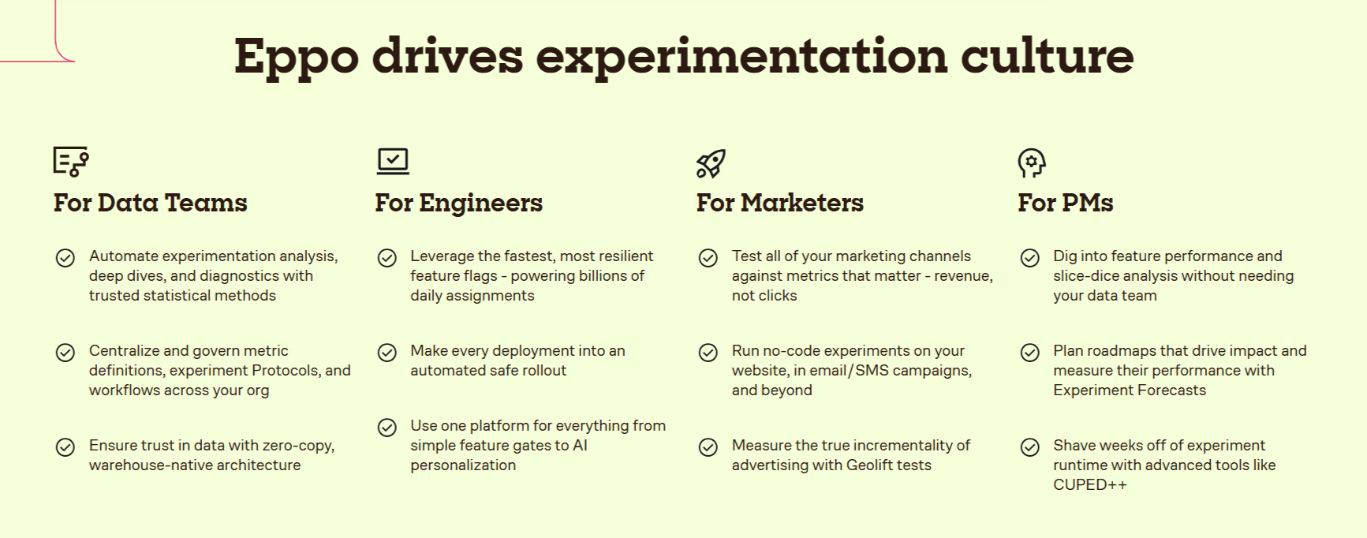
The platform assumes you have analysts who design tests, interpret statistical results, and share findings with stakeholders. Your engineer (or a non-technical user) implements the flags, but the platform’s centre of gravity is the experiment—not the release process.
If you work in a large organisation where experimentation has a dedicated function, it could be the right fit for you.
Flagsmith
Flagsmith puts engineers first. The platform is designed around how development teams actually ship software. For example, they do the following:
- Wrap feature flags around features
- Use gradual rollouts to catch issues early
- Implement kill switches for emergencies
- Use remote config for runtime changes
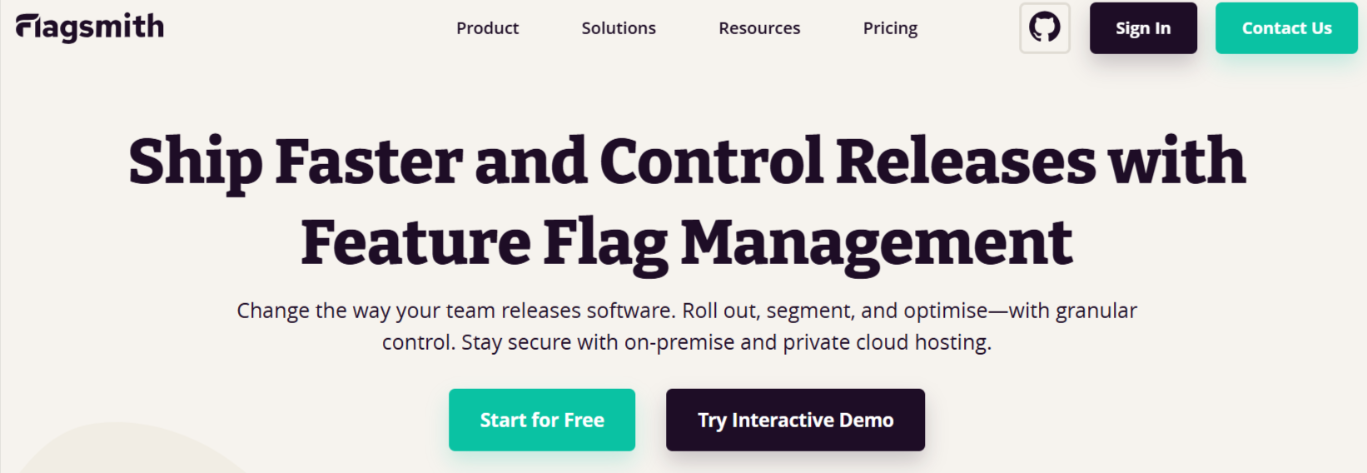
That doesn’t mean product managers are left out. The dashboard gives non-technical team members shared visibility into what’s enabled and for whom.
2. Feature flagging
Eppo
Feature flags in Eppo exist to support experimentation. You can create flags, define variants, and target users, but the functionality is oriented toward running tests rather than managing releases independently.
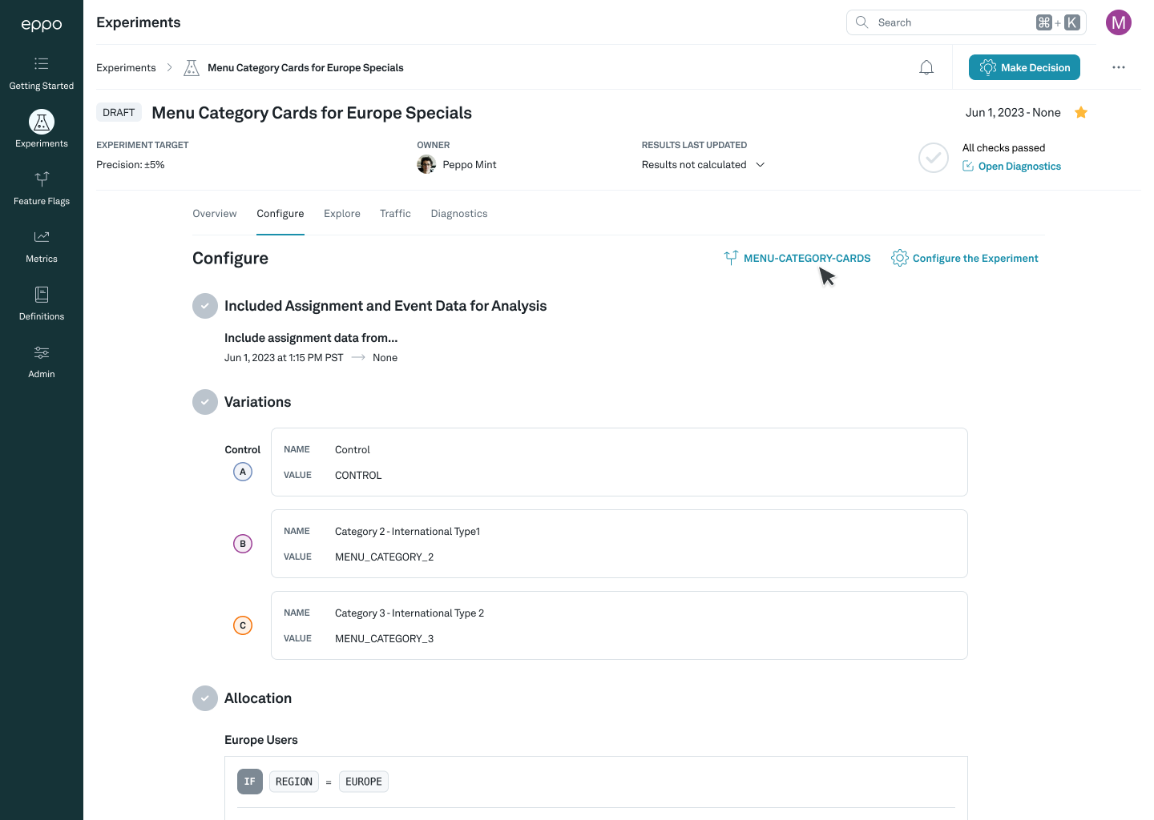
If you need flags for non-experiment use cases (kill switches, entitlements, long-lived operational flags), you’ll find that the tooling’s limited. There’s no remote configuration for arbitrary values. And you can’t manage the lifecycle of a flag as granularly compared to other dedicated feature flag platforms.
Flagsmith
In Flagsmith, feature flagging capabilities are the product’s core focus. You get boolean flags, multivariate flags, and remote configuration values in multiple formats, such as strings, integers, and JSON.
You can target users by defining different segments based on user attributes and manage flags across multiple environments with ease.
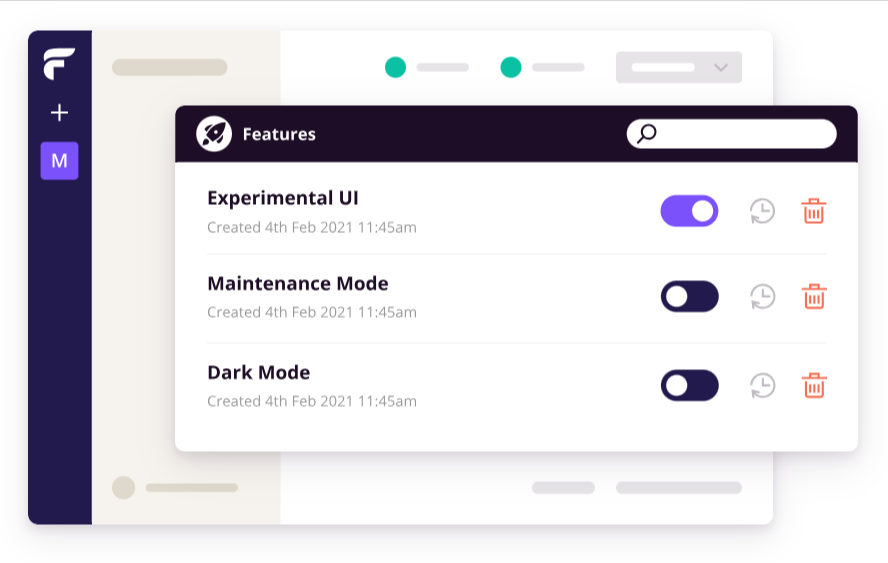
Here’s what one Flagsmith Enterprise user has to say:
“It has improved deployment safety by allowing quick rollbacks and environment-specific configurations. For us, this streamlines e-commerce feature releases, improves experimentation capabilities, and, thanks to its self-hosted option, ensures security compliance.”
You also get additional capabilities like scheduled flag changes, local evaluation for high-performance use cases, low latency, and flag versioning. The platform treats feature flags as a critical, first-class component of its infrastructure.
3. Experimentation and analytics
Eppo
Eppo connects directly to your data warehouse and runs experiment analysis on metrics you’ve already defined. You get advanced statistical methods like:
- CUPED variance reduction
- A/B testing
- Sequential testing
- Bayesian analysis
- Contextual Bandits
And it’ll give you detailed reports like the one below:
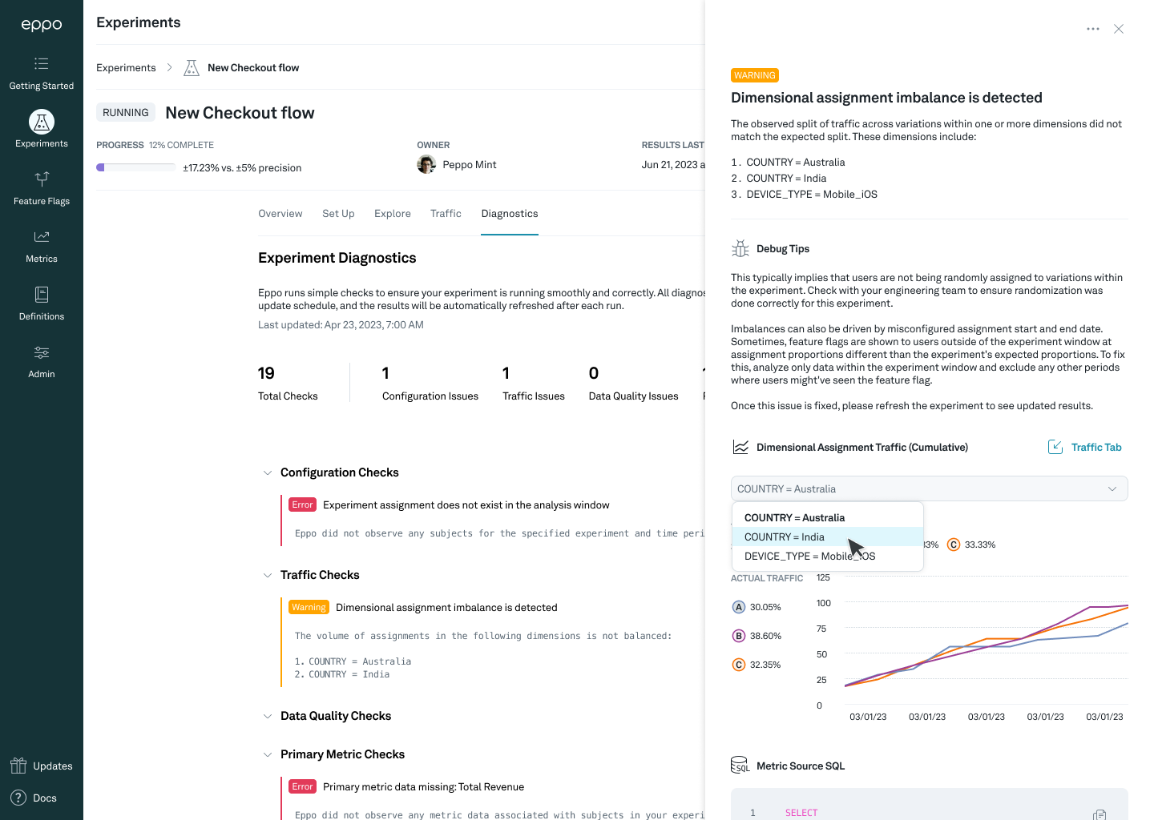
You can track multiple metrics per experiment and set up granular guardrails. Because the analytics function is robust, the reports are easy to build and interpret. As a result, it reduces the manual overhead on product and data science teams.
The tradeoff is that you need the warehouse infrastructure in place. If your data isn’t already centralised in Databricks, Snowflake, BigQuery, or Redshift, for instance, it might not be the right fit.
Flagsmith
Flagsmith lets you conduct A/B testing and multivariate experiments with ease. The analytics are handled through integrations rather than built-in warehouse connections and you can pipe flag evaluation data to tools like Segment, Amplitude, Mixpanel, or your own analytics stack—giving you the flexibility to choose your preferred analytics platform.
4. Pricing
Eppo
Eppo doesn’t publish pricing publicly. You’ll need to go through sales to get a quote, and costs typically scale based on parameters like:
- Data volume
- Experiment count
- Seat numbers
The company was acquired by Datadog in 2024, so its pricing can be influenced by the fact that you’ll get access to features you may not need. And since you need your own data warehouses, you have to factor in those costs too.
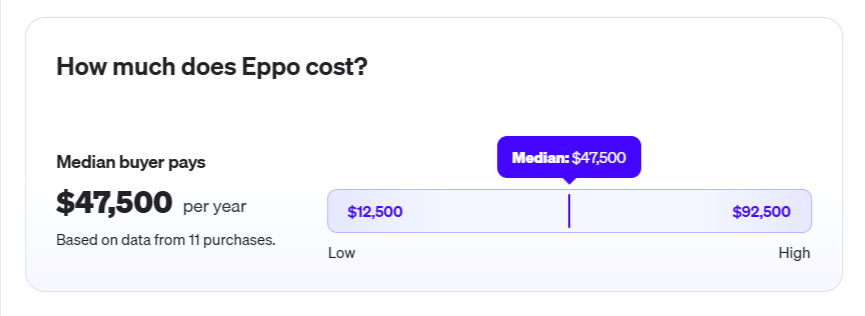
Based on limited data from Vendr, the cost could range from $12,500 to $92,500 per year.
Flagsmith
Flagsmith has a more transparent pricing structure. There are three types of plans:
Cloud deployment
Free plan:
- 1 team member
- Up to 50,000 requests/month
- Unlimited feature flags, environments, identities, and segments
- A/B and multivariate testing
Start-Up at $45/month (with a 14-day free trial):
Everything in Free, plus:
- Up to 1,000,000 requests/month
- 3 team members
- Online T&Cs
- API access
Private cloud, Self-hosted, or Cloud deployment
Everything in Start-Up, plus:
- 5,000,000+ requests per month
- 20+ team members
- Advanced hosting options
- Priority real-time technical support with the engineering team over Slack or Discord
- Governance features – roles, permissions, change requests, and audit logs
5. Open source
Eppo
Eppo is a closed-source platform. The platform runs as a managed SaaS service, and you don’t have access to the underlying codebase. If your industry doesn’t require you to maintain full control of your data for compliance, that’s fine. But it also means you can audit the code or contribute fixes if needed.
You’re locked into the platform even if the roadmap changes.
Flagsmith
Flagsmith is fully open source under a BSD license. The entire codebase, including the API, admin dashboard, and SDKs, is available on GitHub. You can inspect how flag evaluation works and contribute to its improvements.
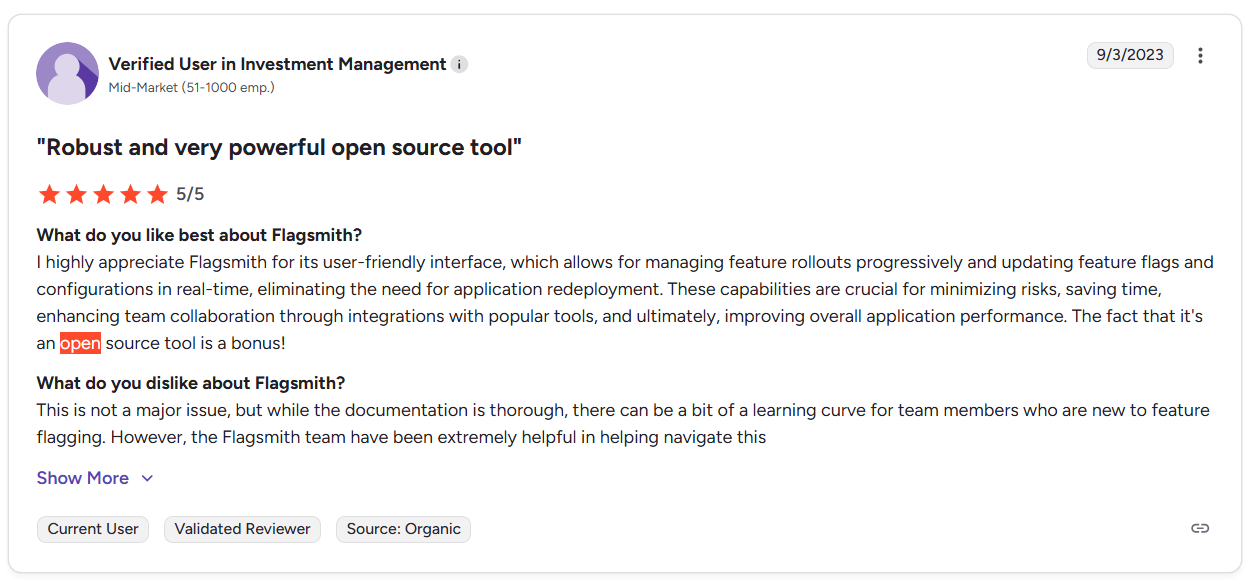
If you do need to move away from it in the future, you can run your own fork. You’re not locked in, and you don’t have to rely on a third-party tool to build critical infrastructure.
6. OpenFeature compatibility
Eppo
Eppo does not currently support OpenFeature. Let’s say you need to standardise on the OpenFeature specification in the future. You’ll need to build custom abstractions or accept tighter coupling to Eppo’s SDK patterns.
Flagsmith
Flagsmith is a founding member of the OpenFeature ecosystem. OpenFeature is a CNCF incubating project that defines a vendor-neutral API for feature flag evaluation. When you code against its interface, your application logic is decoupled from the feature flagging vendor. Use Flagsmith as your OpenFeature provider with SaaS, On Premise, or Private Cloud.
No organisation should be forced to use a specific product. In fact, our leadership sits on OpenFeature’s governance board to shape this initiative. You can find our OpenFeature provider and SDKs here.
7. On-premise deployment
Eppo
Eppo is cloud-only. The application runs on Eppo’s infrastructure, and there’s no option to deploy within your own network.
Your experiment data stays in your data warehouse, but the Eppo platform itself is a managed service. That said, Eppo doesn’t store your raw data per se. It’ll export the aggregated data without any sensitive information and cache it in a Postgres database. Everything is encrypted, so if these requirements work for you, the cloud model should suffice.
However, if you’re in a regulated industry like banking, healthcare, or government, it won’t be the right fit.
Flagsmith
Data sovereignty is key, which is why Flagsmith offers full deployment flexibility. Even though it offers a cloud model, you can also choose to run it on your own infrastructure.
As a result, your flag evaluation data never leaves your network. Your engineering team can manage update schedules, security configurations, and the entire flag lifecycle without compromising security. And when compliance teams need to audit your tech stack, it’s easily available to them.
“With the pure SaaS feature flagging options on the market, there is less control and more risk. Having as much control as possible and ensuring capabilities such as business continuity, failover, and disaster recovery if a system goes down are vital. Flagsmith checked a lot of boxes for us. It was self-hostable, it was feature-rich, and it was affordable.” — Dariel, VP of Cloud Engineering at Delinea
8. Ease of use
Eppo
Eppo’s interface was designed with experimentation in mind. So, if you’re a data analyst or someone with deep experimentation knowledge, the platform can be quite easy to understand. In fact, some users report being up and running within three days.
But if you’re a non-technical user or simply using it to create feature flags for different purposes, it can be confusing at first.
Flagsmith
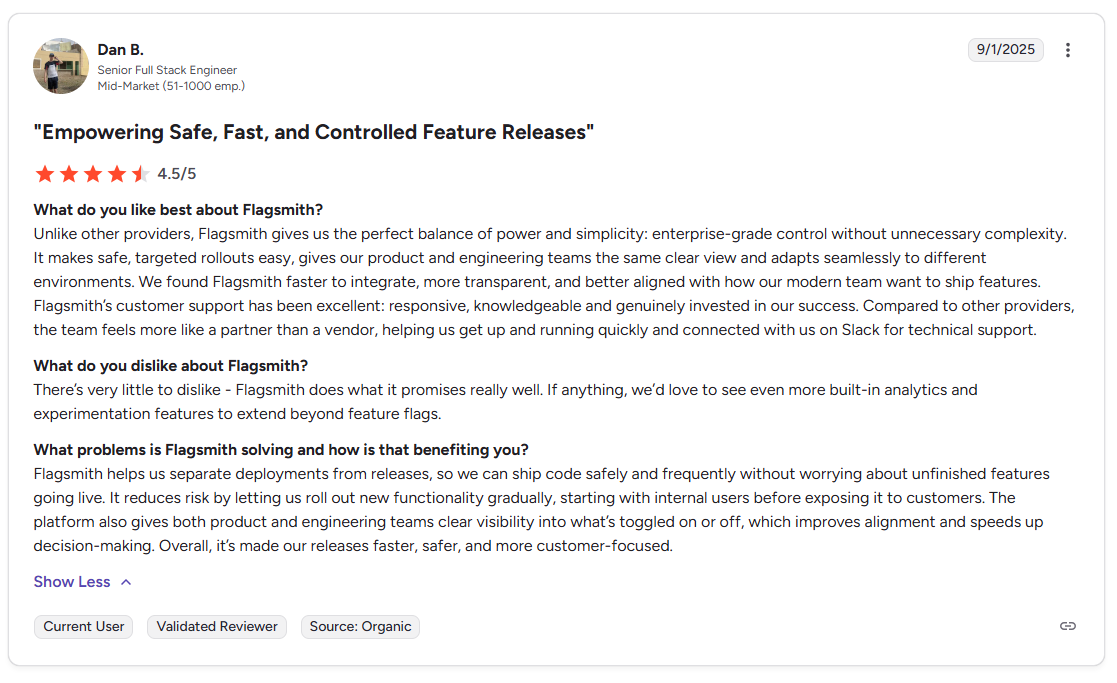
Flagsmith lets you get started quickly. You can create a flag and integrate an SDK in minutes. The dashboard is clean and focused, making it easy to find all your flags, segments, environments, and users.
In short, there’s no steep learning curve. Like one of Flagsmith’s customers said, “You get enterprise-grade control without unnecessary complexity.”
9. Governance
Eppo
While Eppo does have several governance features, it’s not a primary focus of the platform. All the governance protocols are catered towards experimentation.
For instance, the platform offers Experimentation Protocols that act as governance templates for each experiment you run. It lets you reuse standardised process and decision matrices within each template to conduct tests more consistently.
In addition, it offers role-based access controls and audit logs to ensure only authorised users can deploy or stop experiments.
Flagsmith
The platform has governance baked into every feature flagging workflow. You get to use features such as:
- Role-based access controls to define who can create, modify, and toggle flags in each environment
- Scheduled flags to deploy changes only when it makes sense for internal teams
- Audit logs to see who’s making changes and when
- 4-eyes approval workflows to make sure unauthorised changes never get deployed
- On-premise instances that are HIPAA and FedRAMP-compliant
If you’re in a regulated industry, these capabilities make all the difference because they help you stay compliant without dealing with the overhead of maintaining governance separately.
“We’re working with real bank accounts and real money, so code quality and release governance are non-negotiable. Feature flags are critical to making that work. Flagsmith empowers engineers to manage their own releases while ensuring we remain compliant through things like audit logs, roles, permissions, and change requests.” — Dan Bovey, Senior Full Stack Engineer, OakNorth.
10. Integrations
Eppo
Eppo’s integration story centres on the data warehouse and marketing platforms. For the former, it integrates with Snowflake, BigQuery, Redshift, and Databricks. If you’re a marketer, you can also integrate it with platforms like Webflow, Contentful, Shopify, Sendgrid, and Braze.
The interesting part is that it also integrates with other feature flagging platforms, such as Split and LaunchDarkly. If you want to use a feature flagging platform, you can either integrate with it directly or use Flagsmith via webhooks.
Flagsmith
Because the platform focuses on feature flagging, you get access to integrations across the development, communication, and analytics ecosystem. Here’s a list of tools you can integrate Flagsmith with:
- Amplitude
- AppDynamics
- Datadog
- Dynatrace
- Github
- Grafana
- Heap
- Jira Software
- Mixpanel
- New Relic
- OpenFeature
- Rudderstack
- Twilio Segment
- Sentry
- Slack
- Terraform
- Webhooks (to create integrations)
And if there’s a tool that you don’t see here, you can always use the Webhook to create your own.
11. Community and support
Eppo
Eppo provides support through standard enterprise channels. You’ll work with account representatives and support teams, with response times and access levels tied to your pricing tier.
The community around Eppo is smaller, reflecting its focus on a specific use case (warehouse-native experimentation) and its closed-source model.
Flagsmith
Flagsmith offers multiple support channels: documentation, a public Discord community, and direct support depending on your plan. Enterprise customers get dedicated Slack channels with access to the core engineering team.
The open-source community adds another dimension. Issues and discussions happen in public on GitHub. You can see the roadmap, participate in feature discussions, and understand how the project is evolving. For engineering teams that value transparency, this visibility matters.
User reviews*
Eppo vs Flagsmith: Which should you choose?
Ultimately, Eppo and Flagsmith solve different problems, and the right choice depends on where your team needs the most support.
If experimentation is your core workflow, Eppo delivers the depth your data science and product teams need. It already has a warehouse-native architecture and the integrations to support that workflow. Feature flags exist only to serve experiments, and the platform is optimised for that relationship.
But if you’re an engineering leader who wants safer releases, gradual rollout capabilities, and governance for compliance, Flagsmith is the ideal platform. You get advanced workflows for feature flagging and targeting while running simpler experiments to ship with confidence.
You can also deploy the platform wherever you need it while still meeting your industry’s regulatory and security requirements.
Ready to see how Flagsmith fits your workflow? Check out our interactive demo or schedule a demo with us today.
Jindrich Kubat
,
Head of Development
Komerční Banka