

ConfigCat vs LaunchDarkly: Which One Should You Use?
ConfigCat and LaunchDarkly are two well-known feature flag platforms—but they’re built for very different types of teams and workflows.
Built for engineering teams that want feature flags without the overhead, ConfigCat offers a lightweight platform to test features and monitor feature releases with ease.

Built for enterprise teams that need advanced targeting, experimentation, and governance, LaunchDarkly is designed for complex release workflows and compliance requirements.
Flagsmith is a ConfigCat and LaunchDarkly alternative trusted by top development teams


Software teams today are shipping faster than ever. With AI-assisted development, building software is no longer the bottleneck.
But release systems haven’t caught up.
Teams can now build quickly, but they still struggle to safely control what reaches production, who sees it, and how changes are rolled out or reversed.
That’s why choosing a feature flag platform is no longer just about flags. It’s about how you control software change.
Every feature flagging platform promises safety and control, even when you want to move fast. But the platforms rarely deliver on all three aspects successfully.
It comes down to this: are you choosing for today’s convenience or tomorrow’s operational reality?
In this guide, we’ll compare ConfigCat and LaunchDarkly across 10 key factors—and introduce Flagsmith as an alternative for teams that want both speed and control.
ConfigCat vs LaunchDarkly at a glance
ConfigCat is a cloud-native feature flag and remote configuration platform built for simplicity. It doesn’t charge by seats or MAUs, making pricing predictable as your team scales.
LaunchDarkly, on the other hand, is the original player in feature flag management. Over the years, it has grown into a platform for enterprise teams that need advanced targeting and experimentation capabilities.
Comparing ConfigCat vs LaunchDarkly


Jindrich Kubat
,
Head of Development
Komerční Banka

The key differences between ConfigCat and LaunchDarkly
If you’re only focused on feature flagging
ConfigCat does feature flags well and doesn’t try to be anything else. You get capabilities like:
- Targeting rules
- Percentage rollouts
- Segments
- Environment and user management
If your goal is simply to decouple deployment from release and ship features safely, ConfigCat works well.
LaunchDarkly goes further.
It offers:
- Advanced targeting logic
- Experimentation tooling
- Approval workflows
- AI configuration controls
But that added power comes with increased complexity, longer onboarding times, and higher costs—especially at scale.
User reviews
If you prefer an easy setup and onboarding process
ConfigCat is designed for simplicity. Many teams can get started in hours without needing support.
LaunchDarkly has a steeper learning curve. It’s powerful, but requires more time to understand and adopt—especially across multiple teams.
If you need strong security and control over flag evaluation
ConfigCat’s architecture is designed for simplicity—but that simplicity comes with tradeoffs that are important for security-conscious organisations to understand.
All flag evaluations in ConfigCat happen locally. Both server-side and client-side SDKs work by downloading a publicly accessible JSON file that contains all flag data, including segment names and targeting rules.
This means that:
- Flag names, segment definitions, and targeting logic may be exposed publicly
- Sensitive or proprietary information embedded in flags could be visible outside your system
Another consequence of this architecture is that ConfigCat does not store user information. This requires your application to provide full user context at evaluation time, which isn’t always possible—or performant—at scale.
To work around these limitations, ConfigCat offers a proxy. However, this introduces additional infrastructure to manage and creates another potential point of failure.
LaunchDarkly, on the other hand, evaluates flags via its hosted service. This avoids exposing flag rules publicly, but comes with a fully SaaS-based model—meaning you don’t control where evaluation happens.
Flagsmith takes a different approach.
Flag configurations and segment rules are never publicly exposed, and access can be restricted so that sensitive flags are only returned to server-side SDKs. Flagsmith also supports local evaluation for server-side SDKs only—reducing latency and API calls without exposing logic client-side.
For teams that need more control or performance, Flagsmith can be self-hosted or deployed with its Edge Proxy. This allows you to keep flag evaluation within your own infrastructure while optimising for scale.
Flagsmith also supports real-time flag updates out of the box using Server-Sent Events. In contrast, ConfigCat requires its proxy layer to enable real-time updates.
If you need experimentation and analytics features
LaunchDarkly has invested heavily in experimentation.
You get:
- Built-in statistical analysis
- Experimentation workflows
- Flag impact insights
ConfigCat offers basic rollout capabilities, but lacks native experimentation and analytics.
Flagsmith provides a middle ground. It integrates with analytics tools like Amplitude and Mixpanel, and includes built-in insights—allowing teams to experiment without the overhead or cost of a full experimentation suite.
How to choose between ConfigCat and LaunchDarkly
When you’re making your decision, use the following parameters to make your decision:
- Feature flagging workflows
- Open-source software
- Ease of use
- Pricing
- AI feature management
- Deployment options
- Experimentation capabilities
- Enterprise governance
- Security and compliance
We’ve found that ConfigCat is a much better fit when you prefer a predictable cost structure and only need it for feature flagging. But LaunchDarkly is better for situations where you need extensive experimentation and AI-focused capabilities.
That said, neither of these platforms are fully open source. is offers open-source SDKs, but the platform itself is not. If you need to audit the code or want to avoid vendor lock-in, you’re better off using Flagsmith.
ConfigCat vs LaunchDarkly: Key factors for evaluation
1. Feature flagging
ConfigCat
ConfigCat’s main focus is feature flagging, so that’s what it does well. You get capabilities like boolean and multivariate flags, percentage-based rollouts, user targeting with custom attributes, and segment management. Even the targeting rules are straightforward. You just need to define the conditions and deploy as needed.
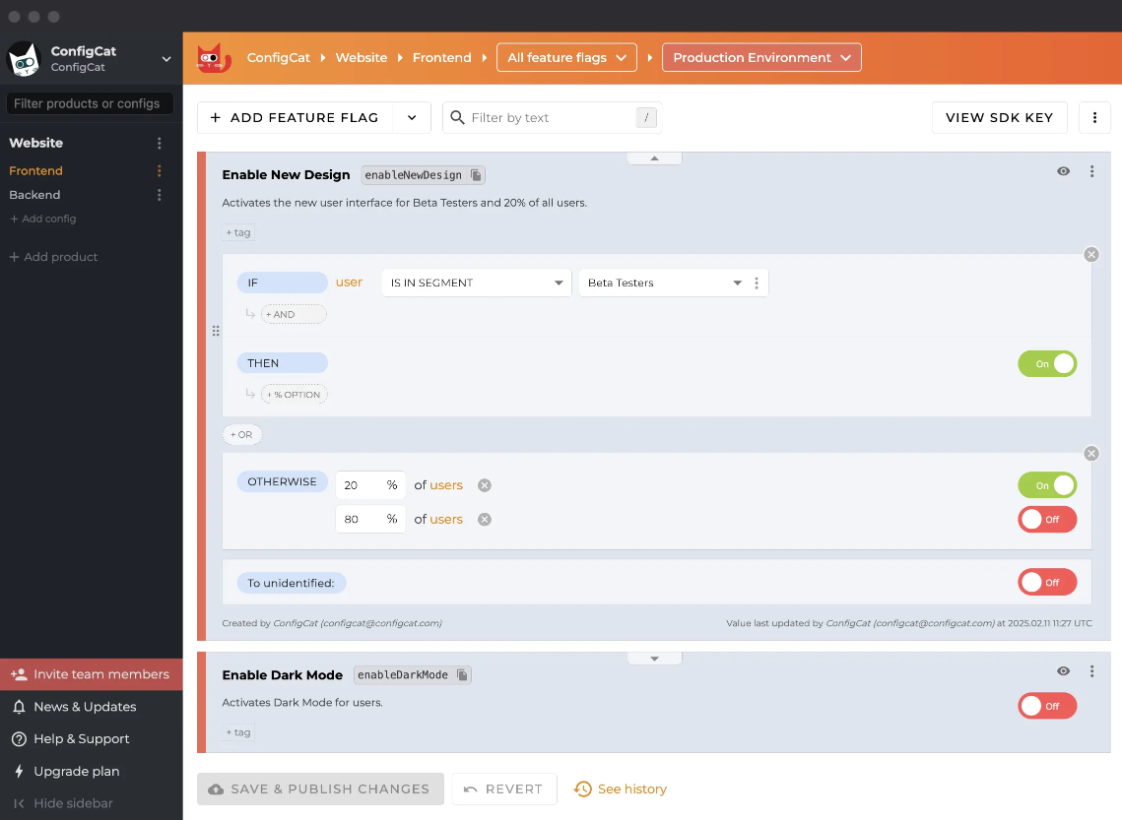
Since the platform supports multiple environments out of the box, you can maintain separate flag configurations for development, staging, and production.
LaunchDarkly
LaunchDarkly takes this a step further. You also get the following:
- Complex boolean logic
- Nested conditions
- Flag lifecycle management
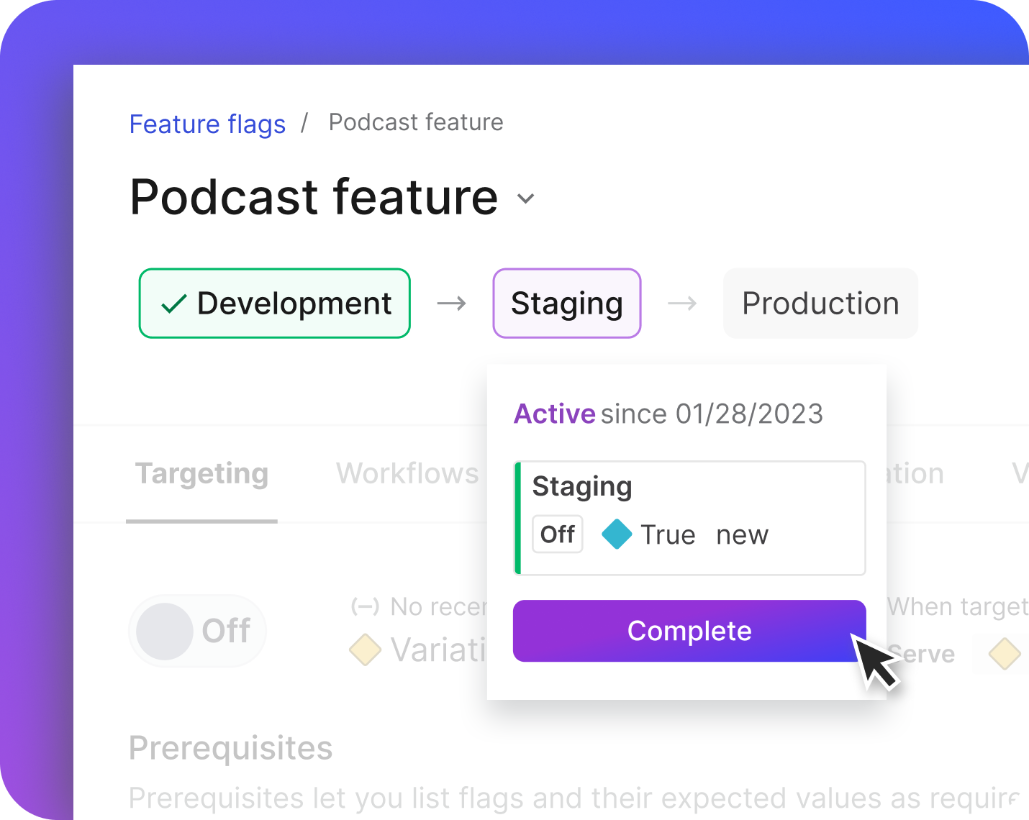
More recently, the platform has launched the concept of “Contexts,” which is essentially its version of user targeting. Contexts let you evaluate flags across multiple entities at the same time. It treats every flag evaluation as a full group—for example, a single flag evaluation could include a user, their organisation, and their device.
Many users have reported that it feels unintuitive to target groups this way. It can get complicated when you’re using it.
What’s missing?
Both platforms are SaaS-first and don’t offer a generous free tier for feature flagging. ConfigCat limits users by the number of flags and environments, while LaunchDarkly limits users by the number of segments and its granular capabilities.
Flagsmith solves for both. If you’re a smaller business or at the beginning of your feature flagging journey, you get unlimited flags and environments in the free tier.
2. AI feature management
ConfigCat
ConfigCat doesn’t offer AI-specific features. You can manage AI-related configuration the same way you’d manage any other feature. For instance, you can create feature flags for model selection or remote config for prompt templates. But that’s where the capabilities stop. You don’t have dedicated tooling for AI-assisted development or AI features in general.
LaunchDarkly
LaunchDarkly has a dedicated AI config section that lets you control the entire AI lifecycle. You can test features in a sandbox and swap models or adjust prompts without redeploying.
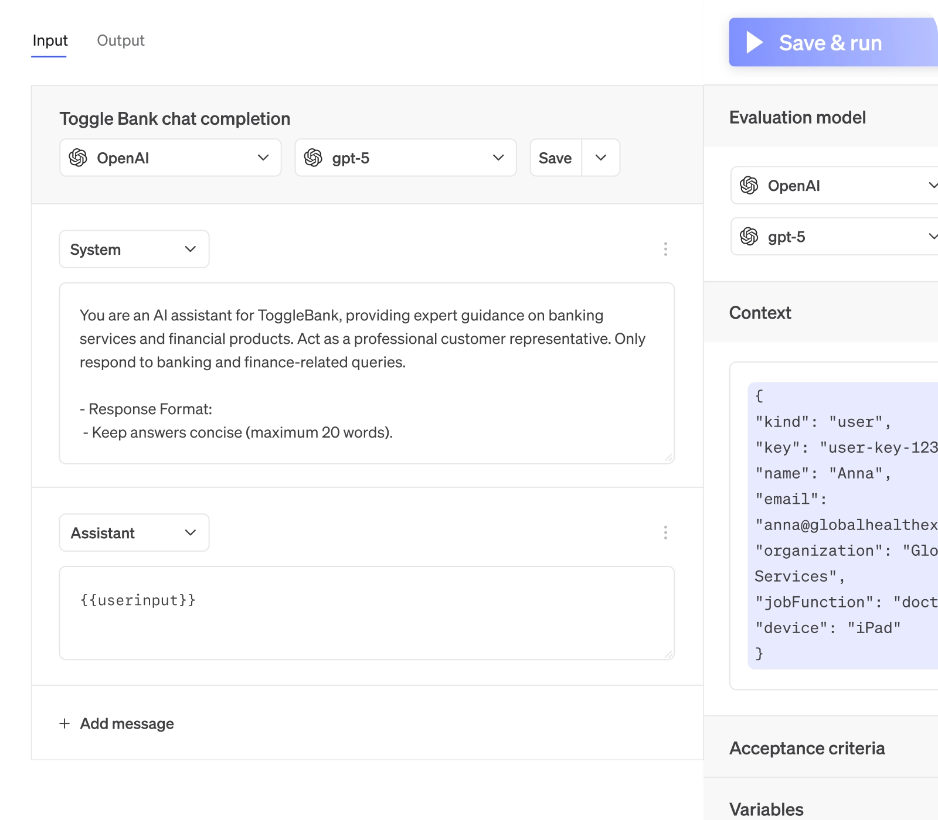
You can also use “guarded releases,” which act as circuit breakers that automatically roll back if model outputs degrade.
What’s missing?
If you need a more cost-effective or open-source solution for AI-driven development, Flagsmith offers a better option. AI feature management is still maturing, especially in regulated industries. You can deploy AI-powered features behind feature flags and even automate the entire release process.
If you need advanced governance within your AI tooling, it helps with that, too. So you can test features and roll them back in seconds if something goes wrong.
3. API access
ConfigCat
ConfigCat provides a comprehensive REST API for managing flags and related settings programmatically. For example, you can create and modify flags or query flag states through the API. The Public Management API covers most operations available in the dashboard.
Some users report that it gives you full control over its features and scales well in the long run.
LaunchDarkly
In the same vein, LaunchDarkly’s API also works well. Given the breadth of the platform, the API is extensive, providing programmatic access to experiments, metrics, audit logs, and team management.
You also get more flexibility if you want to build internal tooling or automate flag lifecycle management. But it does take weeks or even months to set up, so you’ll need additional support to make it happen.
What’s missing?
The key difference is that while both platforms offer API access, they’re not open source. So you can’t inspect or modify the code to suit your needs. Flagsmith provides those capabilities because our core platform’s codebase is open source. We also have community users contribute to its improvement.
4. Analytics and experimentation
ConfigCat
If you need extensive experimentation features, such as multi-arm bandits and AI experimentation, ConfigCat falls short.
You can run percentage-based rollouts and use multivariate flags for A/B tests, but there’s no built-in statistical analysis. You’ll have to export flag evaluation data or integrate with your analytics tool to measure these outcomes.
LaunchDarkly
On the flipside, LaunchDarkly includes a full experimentation suite. You can run experiments with proper statistical controls and see results directly in the platform. If you need to calculate statistical significance, you can do so as well. That’s why it’s better suited for data science and product teams, as they tend to overlook these processes more.
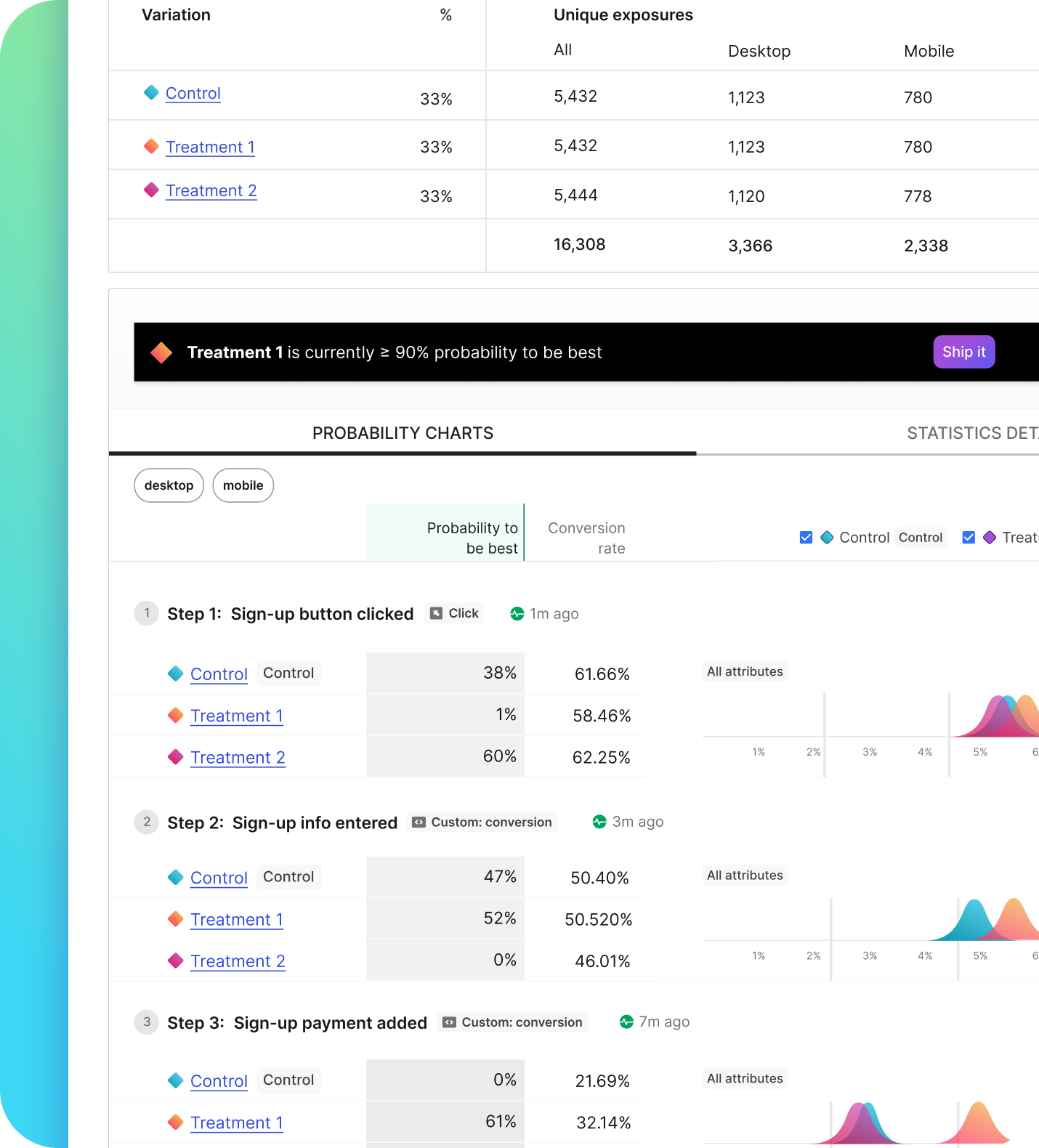
Some users appreciate that the feature flagging and experimentation suite is bundled, but it has also become an issue as costs get out of hand, and the UI becomes clunky when you scale usage.
What’s missing?
Everything comes at a price, and that’s the biggest drawback with LaunchDarkly’s experimentation suite. As you continue adding flags, users, and environments, costs can quickly become unmanageable. But you can’t do the same things with ConfigCat either.
If you want a middle ground, Flagsmith could be a better fit. It integrates with analytics tools such as Amplitude, Mixpanel, and Segment. It has its own built-in analytics tool that tells you how flags are performing. If you need to run extensive experiments at a lower cost, the integrations offer a better path.
5. Pricing
ConfigCat
ConfigCat offers a transparent pricing model with a free tier and four paid plans, which include the following:
- Free: Unlimited seats, 10 feature flags and two environments
- Pro: $120 per month for 100 feature flags, three environments, and three products
- Smart: $360 per month for unlimited feature flags, environments, and 10 products.
- Enterprise: $1,000 per month for unlimited flags, environments and products.
- Dedicated: Contact for a quote, and you can either manage the data in a private cloud or your own infrastructure.
LaunchDarkly
LaunchDarkly’s pricing is far less transparent—particularly at the enterprise level. It has a free tier and three paid plans:
- Developer: Free plan with unlimited feature flags and seats, but only 5,000 service connections.
- Foundation: $12 per service connection per month and $10 per 1,00 client-side MAU per month.
- Enterprise: You need to contact them for a quote. In this tier, you’ll get advanced targeting and release management features.
- Guardian: You need to contact for a quote. You get access to features like release monitoring, guardrail metrics, and advanced observability capabilities.
As you scale and keep launching successful products, the costs will increase, so you need to factor this in.
Here’s what a G2 user says:
“One downside of LaunchDarkly is its complexity at scale, particularly when managing a large number of feature flags across multiple environments. It can be challenging to maintain flag hygiene, and the cost can increase significantly as the usage grows. Additionally, the UI might feel cluttered when dealing with numerous flags, making it difficult to find specific ones quickly.”
What’s missing?
Flagsmith offers an open-source and closed-on-premises option without a per-seat or per-MAU charge. You get governance features, such as role-based access and scheduled flags, with real-time technical support via Slack or Discord. You can find our pricing here.
6. Open source software
ConfigCat
ConfigCat is not open source. The platform is proprietary, so you’re dependent on its roadmap and pricing decisions.
That said, ConfigCat’s SDKs are open source and available on GitHub, so you can see exactly how flag evaluations happen on the client side.
LaunchDarkly
LaunchDarkly is also proprietary. Like ConfigCat, their SDKs are open source, but the core platform is closed. Also, if you start with LaunchDarkly’s platform, it can be challenging to migrate later.
What’s missing?
If you value the transparency and flexibility or open source, while avoiding vendor lock-in at a fundamental level, neither of these platforms fits the bill.
In those cases consider Flagsmith, which is open source under a permissive BSD license. You can audit the code, contribute to feature development, and self-host if needed. It’s also a core part of OpenFeature’s project, so we encourage users to adopt a vendor-neutral platform first.
7. On-premise deployment
ConfigCat
ConfigCat offers a dedicated on-premises deployment and is fully Dockerised. It’s relatively uncommon in the feature flagging space, as few platforms offer this option.
LaunchDarkly
LaunchDarkly does not offer on-premise deployment. That means all your flag configuration and management happens within its infrastructure. They do offer security and compliance certifications such as SOC 2 and HIPAA, but there’s still a risk if you’re in a regulated industry that requires on-premises deployment.
What’s missing?
Ultimately, ConfigCat is still a proprietary solution even if it has open-source SDKs. You’ll run their code in your environment.
With Flagsmith, that’s not the case. You have the option to deploy on-premises with open-source licensing. As a result, you get data sovereignty and full transparency. You can deploy the containerised platform using Kubernetes or Helm. Plus, it’s HIPAA, FedRAMP, GDPR, and SOC 2 compliant.
8. Governance
ConfigCat
ConfigCat provides role-based access control (RBAC) and audit logs. It also supports change requests, approval workflows including four-eyes approval, and scheduled changes. Approval requirements can be configured for individual environments.
As for data retention, the period differs based on your pricing plan, but it can be anywhere from 7 days to 2 years.
LaunchDarkly
LaunchDarkly includes standard RBAC and audit logs, along with approval workflows and prerequisite or dependent flags, so you can manage relationships between different features at scale. However, LaunchDarkly offers those features at a higher price point.
What’s missing?
Flagsmith gives you advanced security and governance features at a more affordable cost, while being open source first and foremost. Here’s what you can expect in the enterprise version:
- Scheduled flags
- RBAC
- 4-eyes approval workflows
- Change requests
- Custom fields
- Unlimited audit log history
- Real-time flag updates
- User roles and permissions
- Release pipelines (currently in beta)
9. User experience
ConfigCat
ConfigCat was designed for simplicity, and the user experience reflects that. Many users say they can find what they need quickly and that it’s easy to set up. They don’t have to hunt through nested menus or deal with unrelated features. But if you’re working with non-technical team members, it can get confusing and hard to navigate.
LaunchDarkly
Many users say that LaunchDarkly’s interface is more complex. But there’s a caveat there. It has a robust feature set, but adding more features comes at the cost of longer implementation timelines and initial adoption issues.
As your flag count grows, so does the complexity. A G2 user reported that the UI can feel confusing when managing a large number of flags across different environments.
What’s missing?
ConfigCat and LaunchDarkly are two sides of the same coin in terms of ease of use. But that doesn’t mean there’s no middle ground.
For instance, Flagsmith provides enterprise-grade features without complexity. You get everything from flagging to segmentation and auditing in the same solution. But the difference is that you can ramp up in hours or days rather than weeks.
10. Integrations
ConfigCat
ConfigCat integrates with the tools most development teams already use. Here’s a list of providers you can integrate with:
- Amplitude
- Bitbucket
- Bitrise
- CircleCI
- Datadog
- GitHub
- GitLab
- Google Analytics
- JetBrains
- Jira
- Mixpanel
- monday
- Slack
- Terraform
- Trello
- Twillo Segment
- VSCode
- Zapier
- Zoho
If your stack is relatively standard, you’ll likely find what you need.
LaunchDarkly
LaunchDarkly offers 68 integrations as of January 2026 with different analytics platforms, data warehouses, development, automation, and project management tools. Some examples include Snowflake, Trello, Datadog, Segment, Census, CircleCI, and Zapier.
Both platforms have extensive integration lists—and so does Flagsmith. Its integration suite is made for engineering teams so that you can find providers like:
Jindrich Kubat
,
Head of Development
Komerční Banka
User reviews*
ConfigCat vs LaunchDarkly: Which should you choose?
Both platforms solve similar problems—but they make different tradeoffs.
- Choose ConfigCat if you want simplicity and predictable pricing
- Choose LaunchDarkly if you need advanced experimentation and enterprise workflows
But most teams today aren’t just choosing a feature flag tool.
They’re choosing how they manage software change.
As development speed increases, the real challenge becomes maintaining control—ensuring every release is intentional, observable, and reversible.
Flagsmith is built for that reality.
It gives teams the ability to ship faster—without increasing risk—by combining deployment flexibility, governance, and real-time control into a single open-source platform.
“We’re constantly working on developing new features, new capabilities, and new differentiators. We don’t want to delay driving value or delay learning. We use Flagsmith to take a feature, product, or project and break it down into its different releasable chunks and then move on to those as fast as possible before releasing them in very controlled ways. This allows us to avoid bottlenecks and prioritise speed.” – Daniel Bell, Product Director, Sales App, Sunrun.
Jindrich Kubat
,
Head of Development
Komerční Banka
ConfigCat vs LaunchDarkly FAQs
Flagsmith is worth serious consideration—it's open-source, which means no vendor lock-in, full transparency over the codebase, and the option to self-host if data governance requirements demand it.
For development teams in regulated industries, that level of control over where your data lives is difficult to match with a closed-source SaaS tool.
If you need broader product analytics alongside feature rollouts, PostHog is another open-source option, though it approaches feature flags as one part of a larger analytics platform rather than a dedicated solution.
Flagsmith is worth considering, as you can self-host it, audit the code, and avoid the proprietary lock-in that makes switching away from LaunchDarkly so painful down the line.
It supports specific user segments, user attributes, and different feature variations without pushing you onto an enterprise plan to access core functionality.
If experimentation is your primary driver, Split and Statsig are worth evaluating, though neither offers the same open-source flexibility or deployment control.
ConfigCat is a feature flag and remote configuration service built around a simple, client-side evaluation model: SDKs pull a config JSON directly, keeping flag evaluation fast and your end-user data off ConfigCat's servers entirely.
It's a pragmatic choice for development teams who want straightforward feature releases without per-seat pricing surprises. Where it starts to show its limits at scale is in the number of flags, environments, and config JSON downloads available per plan, rather than in targeting capability itself.